Systems Tested

Kettenkritik #1: Peak Consult El Diablo and the Question of ControlKettenkritik #1 Peak Consult El Diablo and the Question of Control

A speaker that forgives nothing, a bass that sticks, and why cables weren't the solution here.

Kettenkritik #1: Peak Consult El Diablo and the Question of Control

Sometimes insight begins with frustration.
My current system came about anything but by chance:
Master Fidelity NADAC C and D as the front end,
the revived Cello Audio Suite as the preamp,
various power amps – and the Peak Consult El Diablo as the speakers.
A speaker that forgives nothing.
And that's exactly what became the problem.
Because for long stretches I didn't really like the result.
Too sluggish in the bass.
Too little definition in the movement.
The music had substance – but no drive.
The classic impression:
Everything there. But nothing moves forward.
So the usual search begins.
Different cables?
Different fuses – eFuse, anyone?
Power cords?
Yes – that changes nuances.
But not the structure.
In this case: measures without substance.
The real cause lay deeper – and it was physically comprehensible.
A speaker like the El Diablo moves a lot of air.
Large cone areas, deep frequency response, high energy in the bass range.
That means:
The power amp must deliver not just power, but above all control.
More precisely:
It must cleanly master the speaker's feedback – the so-called back EMF.
If it doesn't, you get exactly what I heard:
A bass that doesn't stop precisely.
That stores energy instead of guiding it.
That drags out the time structure of the music.
Or, more simply:
It gets sticky.
The McIntosh MC275, which had been driving the Peaks before, showed exactly this behavior.
No matter which tap on the output transformer was chosen – the sound remained restrained.
Only a switch to the Spectral DMA 100 Series 2 brought the first real turnaround.
Suddenly more speed, more order, more control.
But:
Not in every discipline.
Because large speakers place demands not only on precision, but also on composure under load.
And that's exactly where the next limit came.
With a large orchestra, with complex passages, with high dynamics, the Spectral showed very clearly:
I can do this – but not without limits.
The Boulder 1161, on the other hand, made exactly the difference here.
More calm under pressure.
More ease at high levels.
No impression of strain – not even when things really get going.
That's not a difference in sound in the classic sense.
That's a difference in the system's resilience under real conditions.
And then came the point that is most often underestimated:
Placement.
Relatively far apart, clearly toed in, precise distances from the rear wall –
only this geometry truly “unlocked” the system.
Because with a speaker of this size, its position in the room doesn't decide nuances, but structure.
Conclusion:
The El Diablo is not a speaker that lets itself be carried.
It demands precise sources – and above all power amps that are fast enough to control its energy.
Otherwise strength tips over into sluggishness.

Pfeiffer's Chainsaw:
When the bass sticks,
the problem rarely lies in the cable –
but in the control.
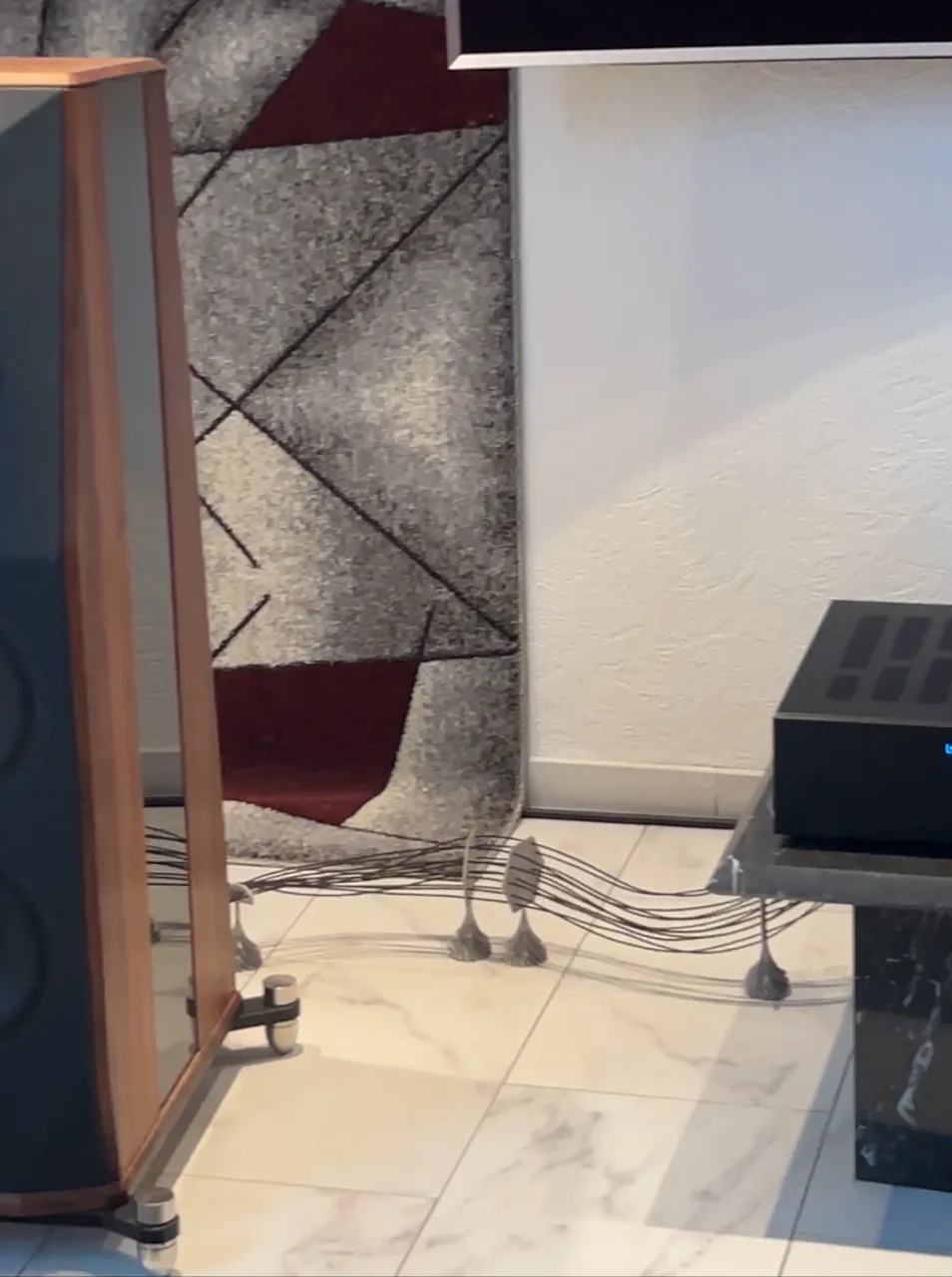
Original post on the Facebook page “Kettenkritik” →

From the discussion

31 comments

Reader’s voiceSent directly to Audio Unscripted

Jan Hendrik Geschke (Audionet und The Voodoo Labs)

· Translated by the editors from the German original

The Peak Consult El Diablo

great topic. This speaker from my longtime employer Wilfried Ehrenholz (two decades at Dynaudio) sits at the place of one of my favorite clients. Big, difficult room. Domed ceiling. Huge windows. Tiled floor. Mostly bare walls. Sounded like a swimming pool at first. Even after installing the finest electronics and multiply patented cables of a very special kind, it still sounded like a swimming-pool opera. Despite rugs and other measures. Tonally it had gotten very good by then, but it lacked sparkle and life. That's just how it is, the big Diablos are a bit tired, I thought. The turnaround (literally - toeing-in is now unnecessary, partly because nothing gets smeared and there are no more dielectric losses, so you don't have to compensate for them anymore either) actually came from a freshly invented power cable combined with a new kind of grounding box (which doesn't ground but ships off HF junk, but that doesn't belong here). Right at the front door - the man listens loud - the paradigm shift was clear, all at once one of the best systems I've ever had the pleasure of hearing had come into being here. The much-longed-for "It's live!", it was there. Gidon Kremer, Bach Partitas, Jesus was in the room. Mutter (whom I don't care for at all), Sibelius Violin Concerto, the entire Philharmonic was sitting in the pool, which wasn't pooling at all anymore. The El Diablo with a masterful performance like I've never experienced before, not even from speakers costing ten times as much.

A personal statement by the sender. It reflects his view, not that of the editors.

“It took me long enough to understand that you can swap stuff back and forth as much as you like… and yes, it'll always be a bit different… but only that, different – not better, if you try to take the room out of the equation.”

A voice from the discussion

The first Kettenkritik was about a sticky bass and a power amp that had too little control. The participants in the discussion pick up the thread, and soon it's about the room, about old Dynaudios and about whether the true high-ender listens active.

The room is part of the chain

A practitioner almost apologizes for his interjection: hopefully the listening room isn't “empty in the modern-architecture way,” with just an armchair and equipment. The editors’ reply on Facebook: “Quite the opposite – a good listening room is rarely empty.” Too little furnishing can be just as problematic as too much; it's about a balance of reflection, absorption and time behavior.

Another tinkerer spent two years building, measuring and listening for this. His lesson: you can swap equipment as much as you like; it'll always be a bit different, “but only that, different – not better, if you try to take the room out of the equation.” But you can also overdo it and linearize everything until it feels “like a workplace.” JP agrees: the room can't be optimized away, and whoever drifts into the measurement lab loses what it's actually about. “How far can I put a system in order without taking away its liveliness?” A third connoisseur confirms this from his own experience. An Accuphase room correction in his former listening room was “nice, but without liveliness and with little dynamics.” In the end he preferred to change rooms.

Boring with the best electronics

A Dynaudio connoisseur knows the sound impression described from older Dynaudio loudspeakers: good, but mostly boring and “endlessly power-hungry.” JP considers this less a question of the brand than of the constellation. When similar virtues meet – lots of control and lots of calm – it quickly tips in that direction. The connoisseur confirms: with the supposedly best and strongest electronics, it was exactly like that. Pleasant to listen to, by contrast, was a Pioneer power amp with an Onkyo preamp on his Compound 2, “not 100 percent precise, but pleasant to listen to, with any music.” JP sees the core in this: “You listen to music – not to the system. Perhaps that's the real challenge: recognizing when less precision means more coherence.”

One commenter thinks the crossovers alone kill the sound; a Dynaudio bass-midrange driver on its own plays “worlds better.” JP considers complexity a legitimate topic but warns against generalizations: a single driver without a crossover doesn't solve other problems.

Active or passive

“That's why the true high-ender prefers active speakers,” a pragmatist interjects. JP calls that a “classic short circuit.” Active can get a lot right, especially in control and tuning. But there are only well or badly implemented solutions. “High end isn't decided by the concept. But by the result.” The pragmatist counters that in the professional field every active speaker meets these requirements. Another finds it all “nonsense,” then on request “everything,” with three laughing smileys. JP stays friendly: “From ‘nonsense’ to is at least a development. In terms of content, though, we're still at the beginning.” And: if it were so clear-cut, “all active systems would have to sound equally convincing. But they don't.”

On the side

A technician writes that amplifiers with current feedback in particular have this problem. Another recommends retuning the El Diablo's drivers with washers. And a third points to a listening room in Berlin-Spandau where the loudspeaker shows on Audionet electronics how it can also sound: “That'll wake you up!”

This summary is based on the 31 comments available on Facebook when they were collected.

Show all comments (30)Hide comments

Comments from the Facebook page in the original German, names shortened.

  1. On Facebook

    Sorry wenn ich dazwischen quatsche... Ich hoffe der Hörraum ist nicht "modernarchitektonisch" leer nur mit Sitzgelegenheit und HiFi Equipment befüllt...

    1. HiFi - Sound + Music♥ 3

      Ganz im Gegenteil – ein guter Hörraum ist selten leer. Der Raum ist kein Nebenthema, sondern Teil der Kette. Zu wenig Einrichtung kann genauso problematisch sein wie zu viel – es geht immer um Balance: Reflexion, Absorption und vor allem Zeitverhalten. Interessanterweise wird genau das oft unterschätzt, während an anderer Stelle sehr viel Aufwand betrieben wird. Insofern: berechtigter Einwurf.

    2. On Facebook

      Hat lang genug gedauert bei mir um zu verstehen, das man Zeuch hin und her tauschen kann wie man will…und ja, wird immer ein bisschen anders…aber eben nur das, anders - nicht besser, wenn man versucht den Raum aus der Rechnung zu nehmen. Das funktioniert bedingt nur mit Kopfhörern… Ich hab aber auch gelernt, man kann es übertreiben und alles komplett versuchen zu linearisieren…so Tonstudio oder Akustiklabor mäßig. Musik hören, erleben geht dann eher auch nicht mehr…fühlt sich eher nach Arbeitsplatz an. 2 Jahre bauen und rumschieben, mit Messungen und Gehör, hat’s mich gekostet…und equipmentmäßig bin ich eher weniger bei Highend, der Physik ist der Preis aber auch relativ worschd.

    3. JP♥ 4

      Das ist ein sehr guter Punkt. Der Raum lässt sich tatsächlich nicht „wegoptimieren“ – er ist Teil der Kette. Und ja, man kann sich dabei auch komplett in Richtung Messlabor bewegen und verliert irgendwann genau das, worum es eigentlich geht. Für mich ist die entscheidende Frage: Wie weit bringe ich ein System in Ordnung, ohne ihm die Lebendigkeit zu nehmen? Und genau da wird es spannend – weil es nicht mehr um „richtig oder falsch“ geht, sondern um Balance.

    4. On Facebook

      sehr richtig, ich hatte in meinem vorherigen Hörraum versucht, mit einem Accuphase DSP den Klang zu optimieren, war nett aber ohne Lebendigkeit und wenig Dynamik. Dann besser ,wie bei mir einen anderen Hörraum nehme.

  2. On Facebook♥ 3

    Diesen Klangeindruck kenne ich von alten Dynaudio Lautsprechern, Axis5, oder Compound 4 usw. gut aber meist aber langweilig und dazu noch leistungshungrig ohne Ende. Ehrenholz halt.

    1. JP♥ 2

      Ich weiß, was du meinst – und die Beobachtung gibt es tatsächlich. Gerade bei älteren Dynaudio-Konzepten war die Kombination aus Leistungshunger und Abstimmung so, dass sie extrem stark von der Elektronik abhingen. Für mich ist das aber weniger eine Frage der Marke als der Gesamtkonstellation. Wenn ähnliche Tugenden aufeinandertreffen – viel Kontrolle, viel Ruhe – kann das schnell in genau diese Richtung kippen. In einer anderen Kombination können genau solche Lautsprecher plötzlich sehr lebendig spielen. Und genau dort wird es interessant: nicht beim Gerät, sondern bei der Passung

    2. On Facebook

      ja genau, so auch mein Eindruck seinerzeit. Mit der vermeintlich Besten und stärksten Elektronik war es wie oben beschrieben, i h hatte z.B an einer Compound 2 eine Pioneer M22 mit einem Onkyo 3090 Vorverstärker, Das war dann zwar nicht 100% präzise usw. Aber schön anzuhören,bei jeder Musik

    3. JP

      Genau solche Kombinationen meine ich. Nicht „perfekt“ im klassischen Sinne – aber musikalisch schlüssig. Eine Pioneer M-22 an einer Compound 2, dazu der Onkyo P-3090 – das liest heute kaum jemand als „Referenz“. Und trotzdem entsteht genau das, worum es eigentlich geht: Man hört Musik – nicht Anlage. Vielleicht ist das die eigentliche Herausforderung: zu erkennen, wann weniger Präzision mehr Zusammenhang bedeutet. Mich würde interessieren: Was genau hat diese Kombination für Sie so stimmig gemacht?

    4. On Facebook

      ;-) Die meisten LS sind Mehrwegler, mit zumeist hochkomplexen Weichen. Diese Weichenbauteile machen dem Klang den Garaus. Bspw. nimm von einer Dynaudio Contour 1.3 nur den Tiefmittelöner, ein 17W75, und den laß in diesem Gehäuse solo, ohne irgendwelche Weichenbauteile, spielen. Klingt um Welten besser - dynamischer, sauberer, verfärbungsärmer - als die originale Zweiwegecontour mit schickem Frequenzgang;-) Diese Erfahrung ist mit allen Mehrweglern mit komplexen Weichen stets.

    5. JP♥ 1

      Der Einfluss von Weichenbauteilen ist ein berechtigtes Thema – jede zusätzliche Komplexität hat ihren Preis. Aber auch hier wäre ich vorsichtig mit Verallgemeinerungen. Ein einzelner Treiber ohne Weiche kann in bestimmten Bereichen überzeugend wirken, löst aber andere Probleme nicht – im Gegenteil. Am Ende geht es weniger um ‚Weiche oder nicht‘, sondern darum, wie stimmig das Gesamtkonzept umgesetzt ist.

  3. On Facebook

    Deshalb bevorzugt der echte HighEnder auch Aktivboxen.

    1. JP♥ 6

      Klassischer Kurzschluss. Aktiv kann vieles richtig machen – vor allem Kontrolle und Abstimmung. Aber „deshalb“ ist genau das Problem. Es gibt nicht die eine richtige Lösung, sondern nur gut oder schlecht umgesetzte. Eine gute Aktivbox kann großartig sein. Eine schlechte klingt trotzdem langweilig. Und eine klug abgestimmte passive Kette kann emotional deutlich näher dran sein. High End entscheidet sich nicht am Konzept. Sondern am Ergebnis

    2. On Facebook♥ 1

      Ebenso klassischer Kurzschluss. Zumindest im fortgeschrittenen Profibereich erfüllt jede Aktivbox diese Voraussetzungen. Und was soll dieses „emotional näher dran sein“? 😂

    3. On Facebook

      Quatsch 👎👎👎

    4. On Facebook

      So, so.

    5. JP

      Dann helfen Sie uns doch auf die Sprünge: Was genau ist aus Ihrer Sicht „Quatsch“?

    6. On Facebook

      - alles 👆😂😂😂

    7. JP

      Vom ‚Quatsch‘ zu 😂😂😂 ist zumindest eine Entwicklung. Inhaltlich bleiben wir aber noch am Anfang.

    8. On Facebook

      - so ist es, am Anfang vom Nichts 🤫 ...

    9. JP

      Am Anfang, ja. Aber nicht vom Nichts – sondern von der Frage, warum manches trotz großen Aufwands nicht funktioniert.

    10. JP♥ 2

      Wenn es so eindeutig wäre, müssten ja alle Aktivsysteme gleich überzeugend klingen. Tun sie aber nicht.

    11. On Facebook

      ;-) Wir haben ersteinmal einen Lautsprecher, eine Box, ein allgemein sehr komplexer mechanischer Zusammenhang. Allgemein eine Dröhn-Rumpel-Krach-Kiste, ohne Expertise in Mechanik, Physik, aufgebaut. Ob die dann passiv oder "aktiv" bespielt wird, ist - relativ zu einer mechanisch bedacht konstruierten "Box" - unerheblich. 999 von 1.000 LS sind mechanisch Klangmüll, egal ob billig oder teuer, ob PA oder HIFi;-)

    12. JP♥ 3

      Der mechanische Aspekt eines Lautsprechers ist ohne Frage zentral – da entscheidet sich sehr viel. Mit pauschalen Aussagen wie ‚999 von 1.000‘ wäre ich allerdings vorsichtig. Dafür ist das Feld zu differenziert. Es gibt sehr unterschiedliche konstruktive Ansätze, die – gut umgesetzt – jeweils funktionieren können. Für mich wird es immer dann interessant, wenn man nicht grundsätzlich urteilt, sondern im konkreten Fall schaut: Was passiert hier im Zusammenspiel von Lautsprecher, Raum und Elektronik – und warum?

    13. On Facebook

      ;-) Mit Wissen um audiorelevante Mechanik ist schnell zu erkennen und auch zu ermitteln, was da wie aufspielt. Ebenso genügt ein Blick bspw. in das Innere von Audioelektronikgehäusen, um das klangliche Potential einzuschätzen. Ein Beispiel für Klangschrott, schlechter geht kaum noch - egal, wieviel Lob ausgesprochen wurde und wird(-:

    14. JP♥ 3

      Ich halte nichts von pauschalen Urteilen wie ‚Klangschrott‘ oder schnellen Einschätzungen anhand von Bauformen. Mir geht es hier um konkrete Hörerfahrungen im jeweiligen Zusammenhang – nicht um Grundsatzdebatten. In diesem Sinne lasse ich es an der Stelle gut sein.

    15. On Facebook

      Das ist eine tendentiöse polemisierende Vereinfachung mit einem Wahrheitsgehalt von 0, dafür viel Sprengwirkung für jeden Diskurs.

  4. On Facebook

    Du hast es richtig ausgedrückt und ich sage dir, dass speziell CFB- Verstärker dieses Problem haben!

  5. On Facebook

    ;-) Eine Einsteigerübung, die auch mit den genannten Endstufen hörbar sein wird: einfach mal einen 4er (?) Inbus nehmen und den Mitteltöner abschrauben. Dann schauen, was da als Dichtmaterial unter dem Korbrand angebracht ist. Sollte das eine Unterlegscheibenhöhe dichten, dann je eine Unterlegscheibe, Metall, je Schraube zwischen Korb und Gehäuse. Wenn Dichtung nicht hinreicht, dann Dichtmaterial, Dichtband unter den Korbrand kleben oder irgendwie anders abdichten. Und ersteinmal hören. Später kann man mittels Unterlegscheiben mal verschieden abstimmen: Bspw. noch je eine unter jeden Schraubenkopf. Oder zwei (klingt anders;-). Oder oder oder. Das kann dann auch bei den Baßtreibern gemacht werden. Und auch beim Hochtöner - sofern man den überhaupt noch brauchte, denn diese kleinen Dinger vermiesen allgemein den Klang. Auch diese Lautsprecher haben nach einer umfassenden Überarbeitung (also viele weitere andere mechanische Maßnahmen und weitere elektonische) ein sehr hohes klangliches Potential - andere Verstärker vorausgesetzt;-)

  6. On Facebook

    Wie das Teil auch klingen kann, demonstriert übrigens Audionet mit VL Carbon Age Master Madness Kabeln im Hörraum in Berlin Spandau. Da wachste auf!