Ortofon 2M Red, Blue or Better Go Straight to Bronze?
Three cartridges on a Braun PCS 52: the Red forgives, the Bronze demands good records, and the Blue is the sweet spot.
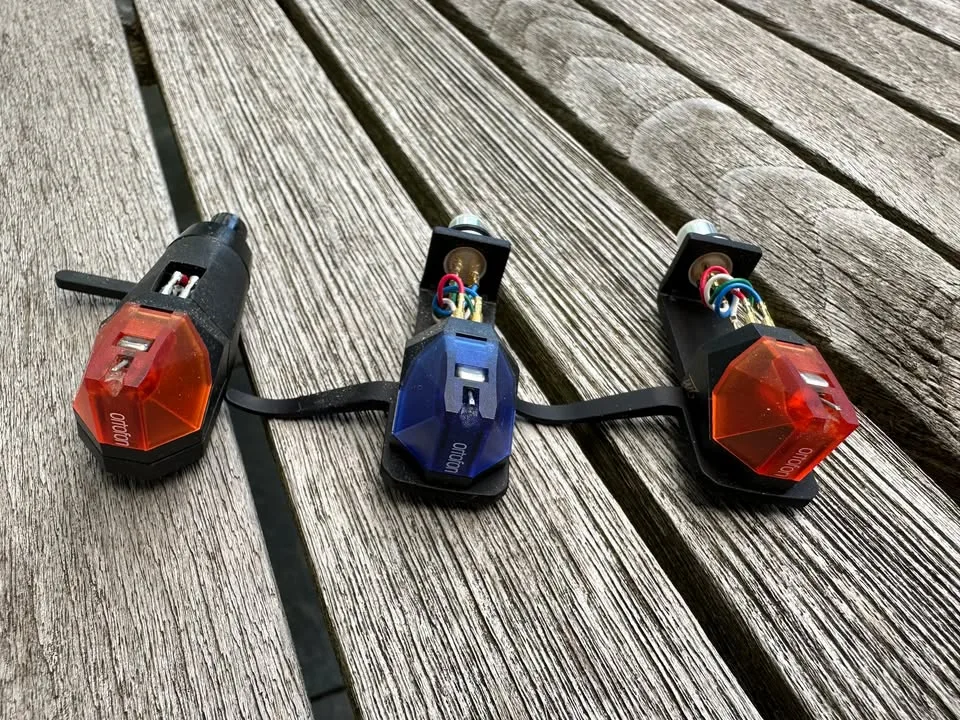
Enough announcements – now it's getting down to business. I listened through the three Ortofon cartridges 2M Red, Blue and Bronze on my Braun PCS 52, which, with its hybrid drive of belt and idler wheel and the SME 3009, is simply a wonderful device for trying something like this. And I can say up front: it actually hardly matters which one you take, because all three cartridges sound much better than their moderate price tag suggests. Ortofon simply can't build bad cartridges. Still, there are differences, and they often depend less on price than you might think – but also strongly on which record is playing. The older the record, the more I feel the 2M Red is the right choice. It sounds a little more superficial in a refreshing way, which I don't mean negatively at all. Especially with older pressings this can be really good, because the Red plays a bit more forgivingly. I attribute this mainly to the stylus: the 2M Red has a bonded elliptical stylus, where the diamond sits on a small metal shank. That adds a little more mass and makes the cartridge minimally more sluggish, which in practice means it's less inclined to mercilessly expose every little flaw or fine scratch. Instead it sounds crisp, fresh and is simply fun. Then I used the 2M Blue. For me, actually the best compromise of the whole series. It sounds airier than the Red without becoming too analytical. Voices step forward a little, details are clearer, but the cartridge always stays musical. That's surely due to the stylus too: the Blue has a nude elliptical stylus, i.e. a diamond without a metal shank, cut and mounted directly. That lowers the effective mass and ensures better tracking. You hear it immediately: more precision, better microdynamics, less distortion, especially in the treble. And yet the Blue is so uncomplicated that older records still sound charming without being taken apart. Finally I tried the 2M Bronze. And it really does get even more out of the groove. Everything becomes a bit bigger: stage, space, calm. Voices sound more natural, sibilants are drawn more finely. But – and this has to be said – the Bronze demands really good records. If the disc is in good shape, the Bronze plays magnificently. But if the record has scratches, noise or simply the typical small production flaws of many sixties pressings, the Bronze may mercilessly expose these weaknesses. That's down to the stylus: the 2M Bronze has a Fine Line stylus, which has a much narrower contact area in the vertical direction and traces deeper in the groove. That provides even better resolution but also makes every little impurity audible. So it's the most ambitious cartridge of the three, but not necessarily the most universal. For me, the 2M Blue remains the sweet spot. It combines the Red's verve with more detail and air, yet stays so relaxed that it doesn't become overcritical even with older discs. So anyone looking for an MM cartridge that can serve audiophile demands as well as offer everyday usability is spot on with the Blue – or rather: true blue. Thanks to Armin Kern, who provided me with the review samples.